No forensics firm in the country has more experience in military courts-martial than Cyber Agents, Inc. That is not a marketing claim. It is a matter of documented case history spanning more than two decades, every branch of the US military, installations on three continents, and cases ranging from junior enlisted soldiers to flag-grade officers.
If you are a JAG attorney or civilian defense counsel preparing for courts-martial, the firm that has seen more of them than anyone else is a resource worth understanding.
A history that starts where others don’t
Cyber Agents has been involved in military cases since at least 2000. The firm began as an 8(a) certified company — a federal small business designation that put us in front of government legal work at a time when digital forensics in courts-martial was largely undefined. We helped define it.
Over the following two and a half decades we have worked more than 380 military cases across the Army, Navy, Air Force, Marine Corps, and Coast Guard. We have worked at installations across the continental United States, in Germany, Korea, Japan, Hawaii, and elsewhere. We have worked alongside JAG defense counsel, JAG prosecution counsel, and civilian attorneys retained by service members facing courts-martial. High-profile cases have included United States v. Manning and the Sinclair matter — cases that drew national attention and required forensic analysis performed under significant scrutiny.
The experience compounds. Having sat through hundreds of full courts-martial — from panel voir dire through closing arguments — we understand not just the forensic analysis but how that analysis lands in a military courtroom, before a military judge, and before a panel of officers and NCOs who evaluate evidence differently than a civilian jury.
What JAG and civilian counsel need from a forensic expert
Military attorneys, whether JAG or civilian, face a specific challenge: the government’s digital forensics work is produced by trained investigators with access to sophisticated tools, and that work arrives in discovery with the institutional authority of CID, NCIS, OSI, or CGIS behind it. The findings are presented as conclusions.
A forensic examiner’s job is to read those conclusions against the underlying data and determine whether they hold. We have reviewed government forensic reports in military cases that misattributed file timestamps, failed to account for device time zone offsets, drew conclusions that the underlying data did not support, and missed evidence that was relevant to the defense. Finding those discrepancies before trial — not during cross-examination — is what pretrial consultation produces.
We also work prosecution-side. When JAG counsel is building a digital case, we apply the same standard: what does the data actually show, where are the gaps, and where will the defense attack. Years of working defense-side cases means we know exactly where those attacks come from.
Trial preparation and in-trial support
Preparation for a courts-martial involving digital evidence is not a one-week project. The government’s forensic report requires thorough review. The defense theory has to be tested against the data. Exhibits need to be developed in formats a panel can follow. The expert has to be ready for cross-examination that will challenge methodology, qualifications, and conclusions simultaneously.
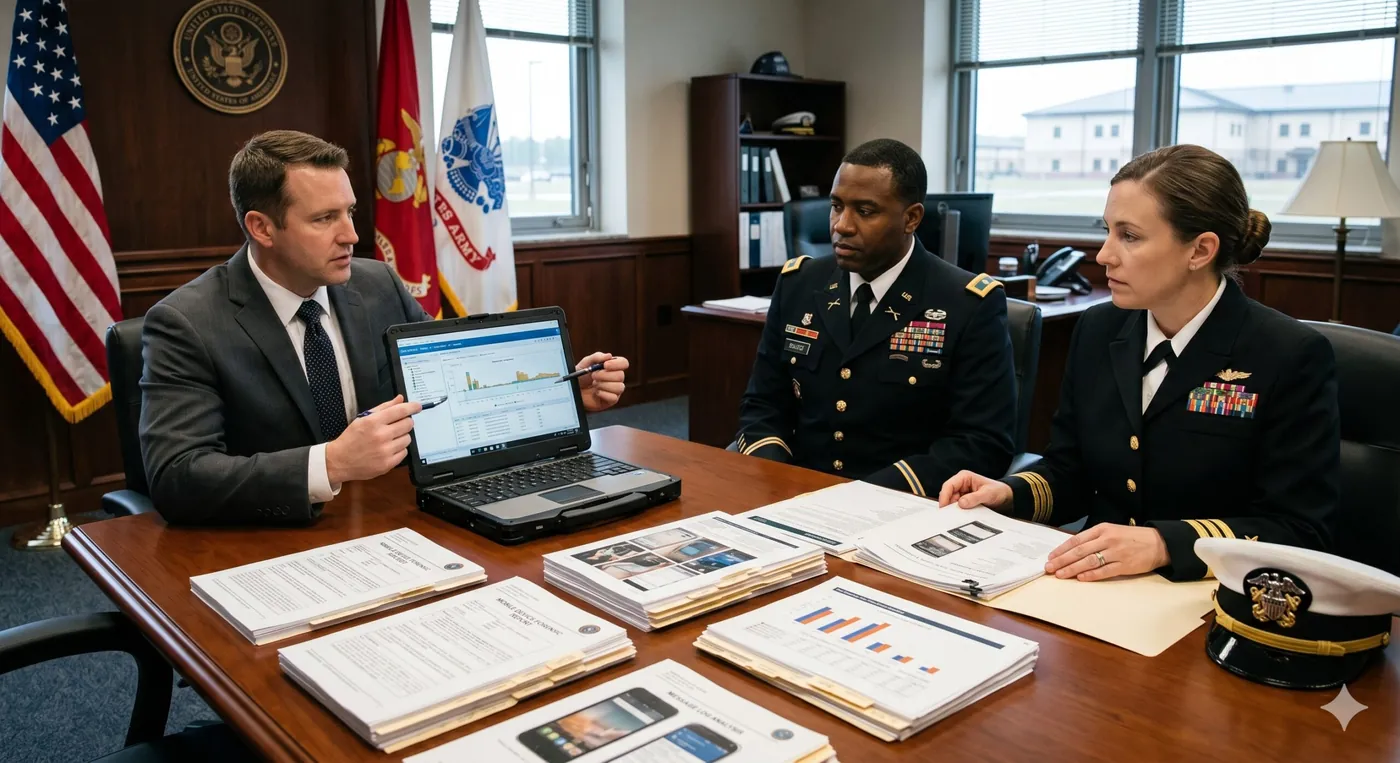
We have been through that process more times than any other private forensics firm working military cases. We know what military judges look for in qualifying a forensic expert. We know how panels respond to technical testimony and how to present complex digital evidence in terms that a non-technical audience can evaluate. We have been present through voir dire, opening statements, the government’s case in chief, motions hearings, and closing arguments. That context changes how we prepare.
In-trial support — sitting with counsel during proceedings, reviewing real-time developments, identifying follow-up questions for cross-examination — is something we have provided in courts-martial at bases around the world.
Client control
Defense attorneys in courts-martial know what every defense attorney knows: the client is not always telling them the full story.
We are sometimes engaged specifically for this purpose. A service member’s device produces an account of their activity that does not depend on what they told their attorney. Location data. Communications. Application usage. The device records what the device records. When the client’s account and the device’s record diverge, the attorney finds out from us before the government does. That finding changes the strategy, changes what can credibly be argued, and changes how the attorney advises the client on plea options.
The digital evidence does not lie. Like a metadata timestamp, it tells the truth whether anyone wants to hear it or not — and the phone tells a more accurate story than the client. Knowing that story early is worth the engagement.
Case types we handle
- Sexual assault, domestic violence, and crimes against persons requiring device extraction, communications analysis, and social media review
- Child sexual abuse material and ICAC-protocol cases at military installations worldwide
- Murder and homicide cases requiring timeline reconstruction, location analysis, and device activity review
- Financial crimes, fraud, and larceny matters requiring email and document forensics
- Narcotics and contraband cases requiring app analysis, communications review, and pattern of activity documentation
- Courts-martial involving government forensic work that requires independent review and potential rebuttal
Why you need an expert with military experience
Courts-martial are not civilian trials in uniform. The rules of evidence differ. The panel composition differs. The institutional dynamics differ. A forensic expert who has testified in federal district court but never in a military courtroom is not the same resource as one who has done both hundreds of times.
According to Cyber Agents’ internal records, its examiners have qualified as experts in courts-martial across all branches without being disqualified We have testified before military judges and panels, survived cross-examination by experienced JAG trial counsel, and provided analysis that contributed to acquittals, charge reductions, and favorable plea outcomes. We are available for consultation, report preparation, pretrial support, and in-court testimony. Our attorneys call us back because the work holds up.
Related services and litigation support
- Courts-Martial / UCMJ
- Mobile Forensics
- Expert Testimony and Trial Consulting
- Remote & On-Scene Collections
Contact Cyber Agents to discuss whether military fits your matter.