
Most corporate data theft is not carried out by outside hackers. It is carried out by employees with valid credentials, authorized access, and years of institutional knowledge — people who know exactly where the valuable data lives and how to move it without triggering an alert.
Cyber Agents, Inc. has worked more than 30 insider threat and corporate espionage matters over the past decade — corporate malfeasance, IP theft, trade secret theft, unauthorized data deletion, and embezzlement cases in Kentucky, Ohio, Tennessee, South Carolina, New Jersey, Indiana, and New York. The common thread across those cases is that the forensic record may reveal more about what an employee accessed, copied, and moved than either side initially expects.
The authorized access problem
When an employee uses their own valid credentials to access company systems and copy data, no alarm fires. The activity looks identical to normal work. By the time the company realizes what happened — often when the employee surfaces at a competitor with suspiciously accurate knowledge of customer pricing, internal processes, or proprietary files — the employee is gone, the device has been wiped, and the company believes the evidence went with it.
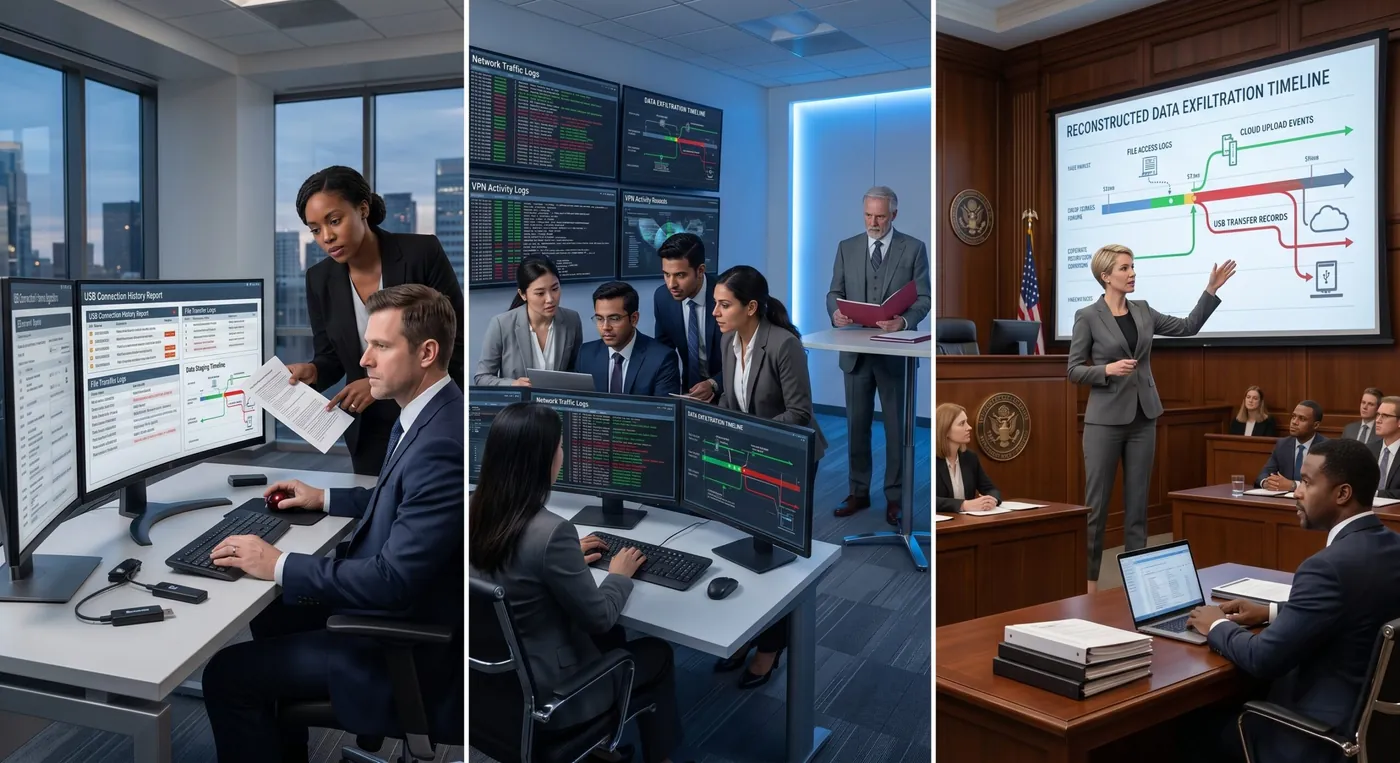
The forensic record survives the wipe. Operating system artifacts, access logs, USB connection history, cloud sync records, and file system metadata document what was accessed, when, and where the data was directed. We have reconstructed the precise sequence of a data exfiltration from a device that had been factory reset. Like a deleted file — gone to the user, still there to anyone who knows where to look — the record of what was taken survived the wipe.
What exfiltration actually looks like
Data leaves a company through a small number of paths. USB drives. Personal cloud storage accounts. Personal email. Airdrop and local wireless transfer. In some cases, through the corporate network itself, to an account the employee controlled outside the company.
Each of those paths leaves artifacts. A USB device connection creates an entry in the Windows registry that persists after the device is removed and after the files are deleted. Cloud sync clients log upload activity that survives local deletion. Email systems retain send records even when the sent folder has been cleared. We examine all of those sources, cross-reference the timeline, and produce a clear account of where the data went and when.
In trade secret cases, the question is not only whether data was taken but whether it still exists. We have verified that specific files were removed from all devices and accounts belonging to a former employee when the resolution required confirmation of deletion, and produced reports documenting that verification.
Communications and coordination
Employees planning to leave with company data often communicate about it. With a future employer. With a co-conspirator inside the company. Sometimes with both.
Those communications exist on company devices, on personal devices if those devices were used for work, in messaging apps, and in email accounts. Extraction of company-issued devices at the time of termination often surfaces messages that predate the formal resignation by weeks or months. We have produced communications timelines showing the coordination between a departing employee and a competitor that began well before the employee gave notice.
The termination window
The highest-risk period for data exfiltration is the window between when an employee decides to leave and when they actually depart. That window is not always visible to the employer. Forensic examination of file access logs, USB connection records, and cloud activity in the 30 to 90 days before termination consistently tells the story of device activity during that period and documents what the employee was preparing to take.
We have worked cases where the employee was cooperative and returned all materials — and cases where hash value comparison between files returned pre-litigation and files produced during litigation revealed the returned set was not complete. The forensic record established exactly which files were missing and when they were last accessed.
Case types we handle
- Trade secret theft and IP exfiltration requiring device examination, cloud account analysis, and data verification across all platforms
- Departing employee cases involving USB exfiltration, personal cloud sync, and email forwarding of proprietary data
- Competitive intelligence theft where a former employee surfaces at a competitor with access to pricing, clients, or internal processes
- Corporate disputes over data ownership, document authenticity, and operating agreement integrity
- Insider threat investigations requiring analysis of access patterns, file activity timelines, and communications review
- Large-scale eDiscovery support in employment and non-compete litigation where communications history is central to the case
Why you need an expert
The opposing argument in every insider threat case is that the employee accessed data in the normal course of their work. The forensic examiner’s job is to show that what happened was not normal — in volume, in timing, in destination, or in the effort made to conceal it.
Cyber Agents has worked corporate espionage matters in state and federal court and in arbitration proceedings. We examine the full digital record, produce reports that document the exfiltration timeline with specificity, and testify to technical findings in terms that a judge, arbitrator, or jury can follow. When the evidence shows deliberate exfiltration, we can show the path it took, step by step.
Related services and litigation support
Discuss the digital evidence in your corporate espionage / insider threat matter with Cyber Agents.