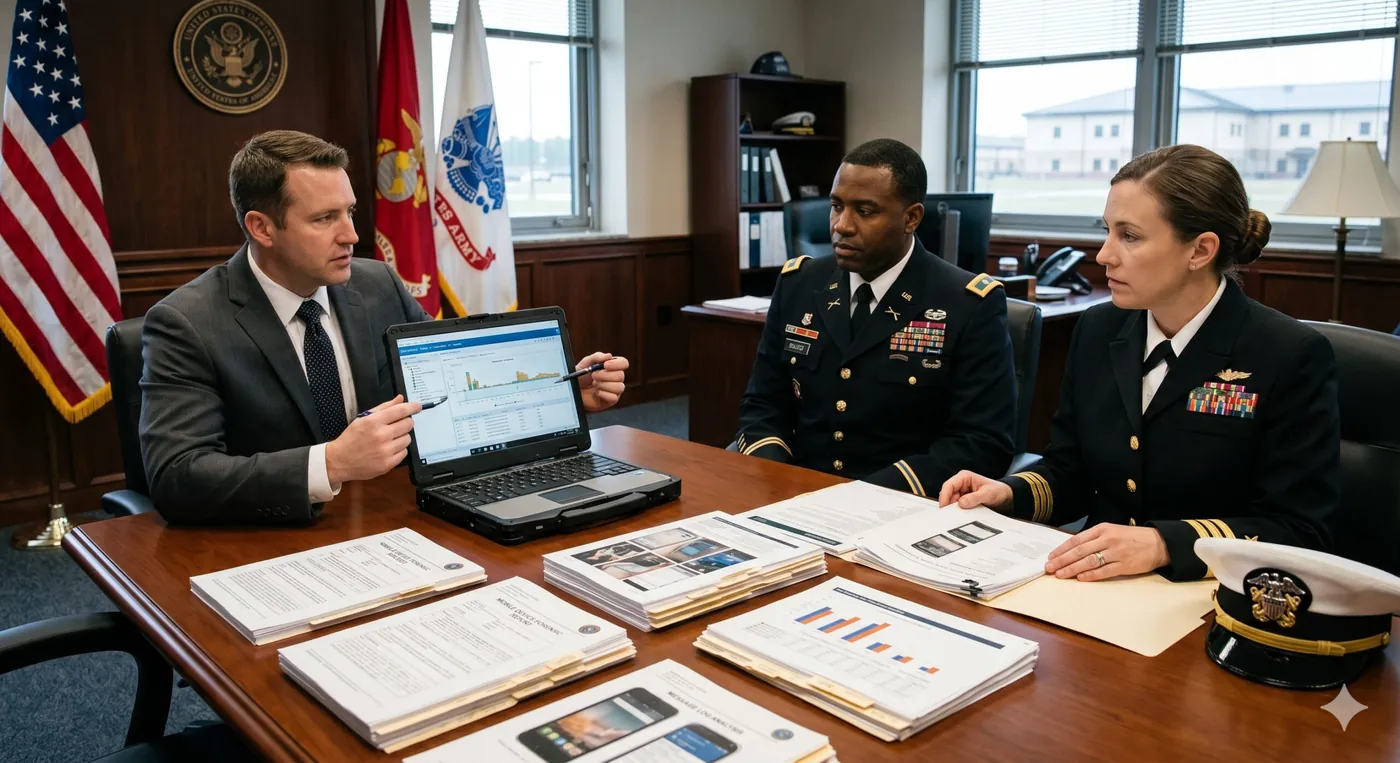
Military courts-martial operate under the Uniform Code of Military Justice, with evidentiary rules and procedural standards that differ in meaningful ways from civilian courts. The digital forensic examiner who works in military proceedings needs to understand how military defense and prosecution systems are structured, how evidence is handled from extraction through court, and how to testify before a military judge and panel in a way that holds up.
Cyber Agents, Inc. has worked more than 380 military matters since 2010 — courts-martial, Article 32 hearings, and related proceedings across every branch of the US military at installations in the continental US and overseas. No Cyber Agents examiner has ever been disqualified in a military proceeding.
Military experience across all branches and installations
We have worked Army, Air Force, Navy, and Marine Corps courts-martial. Army installations we have engaged include Fort Campbell, Fort Cavazos (formerly Hood), Fort Bliss, Fort Carson, Fort Liberty, Fort Wainwright, Wheeler Army Airfield, Camp Humphreys, and others across Korea, Japan, and the continental US. Air Force engagements span Nellis, Eglin, Minot, Malmstrom, Ramstein, Aviano, Kunsan, Barksdale, Cannon, and others. Navy and Marine Corps work includes Naval Air Station Jacksonville, Naval Station Norfolk, Marine Corps Base Hawaii, Camp Lejeune, and Marine Corps Base Camp S.D. Butler in Okinawa.
The overseas component of military practice is significant. We have traveled to Germany, Korea, Japan, Okinawa, and Italy for onsite evidence review and trial testimony. We understand how evidence is transferred between installations, how overseas DTS reimbursement works, and what the logistics of military proceedings in foreign jurisdictions require from an expert.
Charge types we have worked
Military courts-martial in our case database span a wide range of charges. CSAM and child pornography cases make up the largest single category, followed by sexual assault and rape, domestic violence, murder and homicide, solicitation of a minor, human trafficking, narcotics, assault, and reckless homicide. We have also worked cases involving indecent recording, obstruction, no-contact violations, and larceny in military settings.
In CSAM and solicitation cases, the digital forensic record is almost always the center of the case. We analyze the device or account extraction, review the government’s forensic work, authenticate the evidence chain, and identify issues the defense can raise — including NCMEC report discrepancies, hash attribution questions, cloud versus device sourcing, and AI-generated image analysis where the government’s count is incorrect.
In sexual assault cases, the communications between the parties and their locations during the relevant time window are typically the contested issues. We have extracted and analyzed the complainant’s and accused’s devices in many of these matters, identified timeline gaps in screenshot-based evidence, and recovered deleted messages that were not accounted for in the government’s submission.
Working the military funding process
Military defense work runs through the Trial Defense Service, Area Defense Counsel, and related JAG offices, each with their own funding authorization processes. We have worked with TDS, ADC, and individual defense counsel offices across the Army, Air Force, and Navy-Marine Corps systems for over a decade. We understand how funding orders work, what information legal offices need to process them, and how to structure our work to fit within funding approval parameters.
We have also been retained directly by military prosecution — the judge advocate general offices and trial counsel who need an independent expert to support or respond to defense forensic work.
Undercover operation review
ICAC-standard undercover operations conducted by military law enforcement follow specific protocols governing tone, pace, and subject matter. We have reviewed law enforcement undercover chat logs, assessed operational compliance, and identified departures from standard procedure that affected the admissibility or weight of the government’s evidence.
Where an undercover operation does not comply with ICAC operational standards, the record available to defense counsel through discovery often does not make that visible — like a deleted file, the departure from protocol may not appear in what the government presents, but it is there to anyone who knows where to look. We have identified those gaps in military CSAM cases and provided defense counsel with the analysis needed to challenge the government’s evidence.
What we bring to courts-martial
We have testified before military judges sitting alone and before court-martial panels. We have testified at Article 32 preliminary hearings and in evidentiary motions. We have prepared defense counsel for cross-examination of government examiners and have rebutted government examiner testimony directly.
Our examiners hold industry certifications including CFCE, ICMDE, GASF, GCFE, and platform-specific credentials. We have taught at the Naval Justice School and at military trial defense and prosecution advocacy courses. When we testify about how a digital forensic examination should have been conducted, we are drawing on experience teaching those standards to the attorneys and examiners who operate within that system.
Case types we handle
- CSAM and child pornography cases — device extraction, NCMEC report review, platform analysis, AI-generated image identification, chain of custody examination
- Sexual assault and rape cases — communications analysis, timeline reconstruction, screenshot authentication, deleted message recovery
- Domestic violence — device extraction, location data, social media account analysis, message thread authentication
- Murder and homicide — multi-device analysis, cell record analysis, location timeline construction
- Solicitation of a minor and UC operation cases — review of undercover operational records, ICAC standard compliance analysis, device and account extraction
- Human trafficking — multi-device review, platform account analysis, financial communication review
- Narcotics — device extraction, CDR analysis, location verification
How to retain us
TDS and ADC counsel: contact us with a brief description of the case and the expected timeline. We will advise on what forensic work is likely needed, provide an estimate for the funding order, and confirm availability. We work within government funding structures and have experience navigating the approval process across all branches.
Civilian defense attorneys in military proceedings: we are retained the same way as in civilian cases. Contact us to discuss the matter.
Related services and litigation support
Contact Cyber Agents to discuss digital forensic litigation support for your matter.