
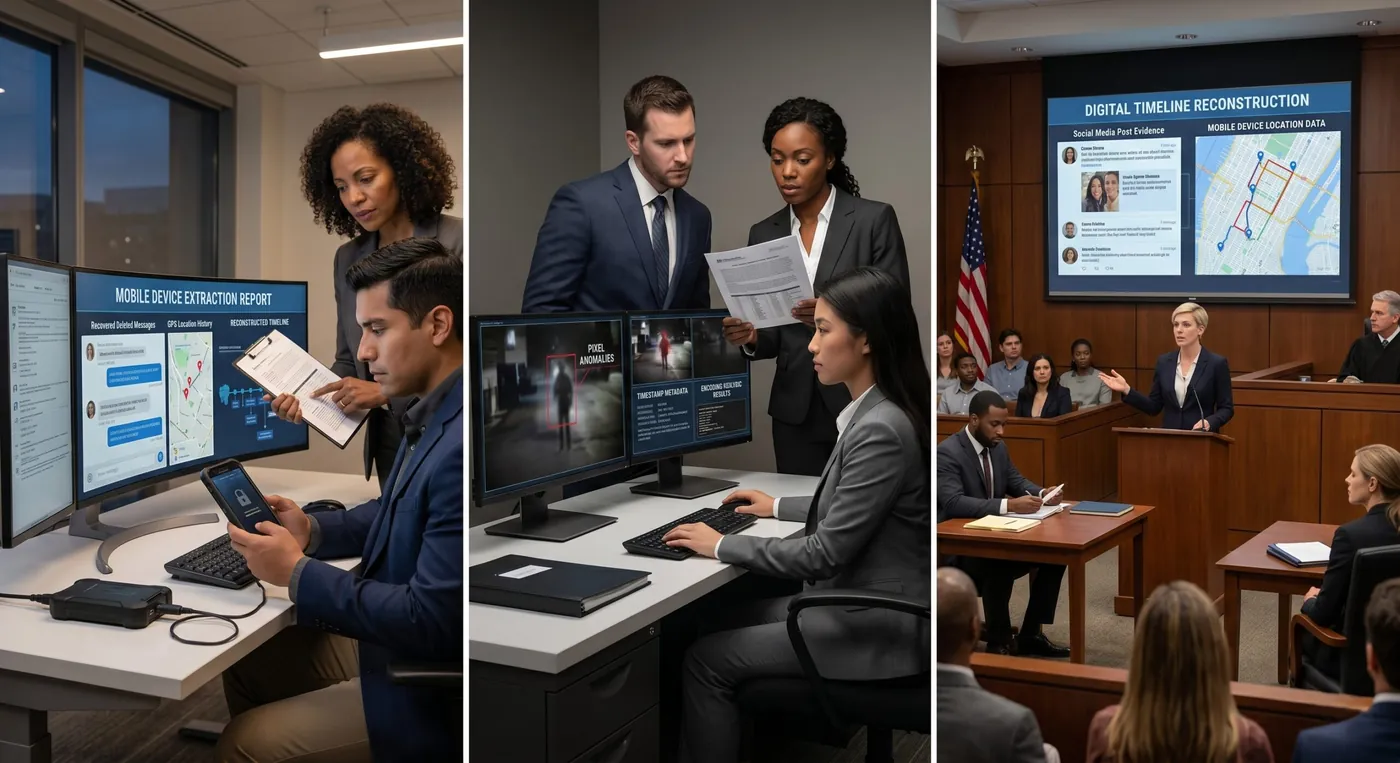
Defense attorneys work with incomplete information. Not because they are not thorough. Because their clients often are not telling them the full story.
Digital evidence does not have that problem. A phone extraction captures what was sent, what was received, what was deleted and when, where the device was at any given moment, and what the user was doing in the minutes and hours that matter most to a case. That record exists independently of what your client tells you. It confirms the account or it contradicts it. Either way, you are better prepared.
Cyber Agents, Inc. works criminal defense cases at the state, federal, and DoD level — more than 530 total defense engagements across 382 military courts-martial and over 150 civilian criminal cases. We have examined evidence in cases involving sexual assault (60-plus cases), murder and homicide (66 cases), CSAM and online solicitation (255 cases), narcotics, financial fraud, arson, robbery, and domestic violence. The work is the same regardless of the charge: examine the digital record, report what it shows, and help defense counsel understand what they are actually working with before it becomes a problem at trial.
How strong is the government’s case
The first question most defense attorneys ask is not what happened. It is what the prosecution can actually prove.
Government digital forensics varies in quality. We have reviewed evidence reports that misattributed file timestamps, failed to account for time zone offsets, and drew conclusions not supported by the underlying data. Metadata on images submitted as evidence can be manipulated, and when the prosecution’s case rests on a timestamp or a file date, the methodology used to establish that date becomes a cross-examination target.
We review prosecution discovery with those questions in mind. What did the government examiner find, and is the conclusion they drew from it supportable? Where are the gaps, and do those gaps matter to the theory of the case?
Mitigating factors and location evidence
Cell records and device location data are among the most useful categories of evidence in criminal defense. We have mapped client locations from call detail records, identified inconsistencies between claimed timelines and actual device activity, and produced geolocation reports that placed a client elsewhere during the period in question.
Communications data between the complainant and the accused is another consistent focus. In sexual assault and domestic violence cases, messages, social media activity, and account history before and after an alleged incident often tell a materially different story than the one in the charging document. We have analyzed Snapchat returns, iCloud records, Google account data, and messaging app histories to surface that record. What the government produced in discovery is not always the full picture.
Client control
Defense attorneys know their clients lie. That is not a criticism. It is a structural reality of criminal defense.
Forensic analysis gives defense counsel an independent source of truth that does not depend on the client’s account — like a metadata timestamp, the record tells the truth whether anyone wants to hear it or not. When the data contradicts what your client has told you, you find out before the prosecution does. That finding changes the strategy. It changes what you can credibly argue. It changes how you advise the client on a plea. And in cases where the client is pushing a theory the data cannot support, it gives you the ground to push back.
We have worked cases where analysis of a client’s own device produced the clearest picture of what the facts actually were. Not the most comfortable picture. The most accurate one.
Case types we handle
- Sexual assault and domestic violence matters requiring communications analysis, complainant account review, and image metadata authentication
- Murder and assault cases involving location mapping, timeline reconstruction, and device activity analysis
- Child exploitation and CSAM requiring ICAC-protocol forensic review, peer-to-peer network analysis, and device examination
- Financial fraud and white-collar matters involving email forensics, document analysis, and transaction record review
- Arson cases requiring device location at the time of the fire, communications evidence, and search history analysis
- Larceny and theft matters involving device activity timelines, location data, and communications review
- Federal and state criminal proceedings, and DoD courts-martial
Why you need an expert
Criminal defense is the highest-stakes context in which digital evidence is used. Findings go directly to guilt or innocence, and an examiner who cannot defend methodology under cross-examination is a problem, not an asset.
Cyber Agents has testified in federal court, state court, and at courts-martial on three continents. According to Cyber Agents’ internal records, its examiners have not been disqualified from trial We work as part of the defense team. When the evidence helps your client, we explain it clearly to the jury. When it does not, you find out from us before the other side does.
Related services and litigation support
- Law Enforcement Investigation Review
- Mobile Forensics
- Cell Record Analysis
- Expert Testimony and Trial Consulting
Discuss the digital evidence in your criminal defense matter with Cyber Agents.