
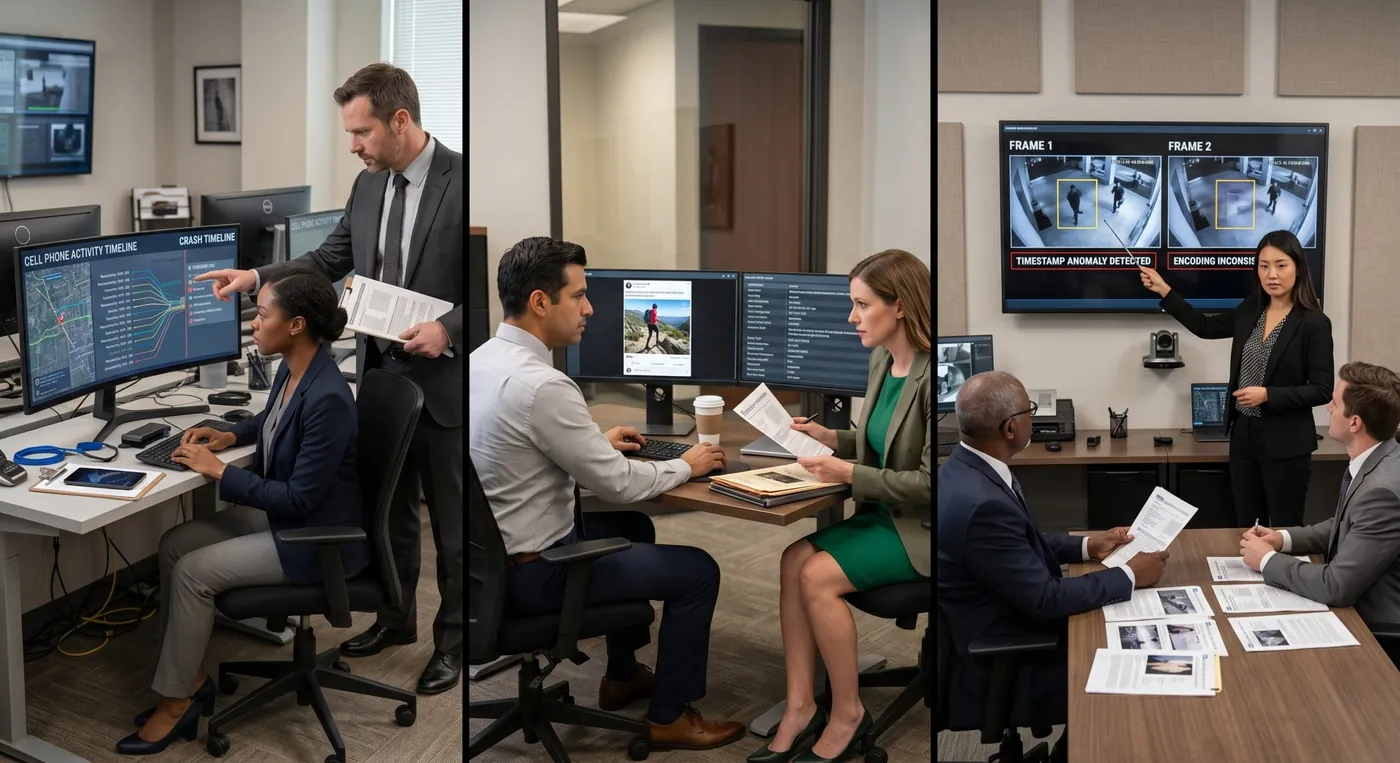
A person is injured. The question is what the entity responsible knew, when they knew it, and whether the electronic record around the incident matches what they are claiming in litigation.
Digital evidence in personal injury cases runs in two directions at once. It can corroborate the plaintiff’s account of what happened and document the extent of the harm. It can also establish that the entity at fault had prior knowledge of the hazard, failed to address it, and handled the incident in ways the internal record does not support. Cyber Agents, Inc. has worked more than 35 personal injury matters — premises liability, auto and commercial vehicle collisions, industrial accidents, and wrongful death — across Kentucky, Ohio, Tennessee, North Carolina, Wisconsin, and other states. The forensic record in those cases is almost always more complete than the produced discovery.
Wearable and health data
Wearable devices are the closest thing to a continuous witness that exists in personal injury litigation. A fitness tracker or smartphone captures biometric data — steps, heart rate, sleep patterns, active minutes — without interpretation or selection. The data reflects what the body was doing, not what anyone remembers or chooses to report.
We have extracted and analyzed wearable device data in wrongful death matters where the clinical record was the only contemporaneous account of a patient’s condition. The wearable’s data told a different story. It documented the subject’s activity and biometric readings in the days and hours before the incident, in a format that a jury can understand without a medical degree.
In injury cases where the extent of harm is disputed, wearable data from before and after the incident provides an objective baseline. Physical activity levels, sleep disruption, and heart rate variability in the weeks following an injury are recorded continuously. That record does not require the plaintiff to testify to how they felt. It shows what their body was doing.
Phone health data works the same way. iOS and Android devices log step counts, distance traveled, and activity type. Location data from the phone places the device at or near the scene and documents the movement pattern before and after. That data can corroborate a plaintiff’s account of where they were and what they were doing when the incident occurred.
What the entity’s internal records reveal
The most significant digital evidence in premises liability and industrial accident cases often does not come from the plaintiff. It comes from inside the organization that caused the harm.
Internal communications on company devices, cloud-stored documents, and shared network drives frequently contain evidence of prior knowledge. Safety concerns raised by employees about a specific hazard. Incident reports from prior events at the same location. Maintenance requests that were submitted and ignored. Warnings that were sent up the chain and not acted on. That documentation exists in the entity’s own systems, and it predates the litigation by months or years.
We have found that internal reports authored about an incident are rarely the only electronic record of that incident. The messages exchanged between employees in the hours after an injury — before anyone anticipated litigation — reflect what actually happened and what the organization’s immediate priorities were. Those communications are recoverable from company devices, personal phones used for work communications, and cloud messaging platforms.
The prior safety record of a location or employer is also accessible through the entity’s own electronic systems. OSHA filings, internal inspection logs, corrective action tracking, and the communications around those records establish the pattern that predates the plaintiff’s injury.
Device activity at the moment of impact
In collision and accident cases, what a device was doing in the seconds before and after an incident is often the most contested fact in the case. We have extracted phone data to establish whether a driver was using their phone at the time of a collision — not just whether calls were made, but whether the device was active, what apps were open, what notifications had been received and whether they were read, and where the device was in the physical environment at the moment of impact.
Cell detail records from the carrier layer on top of device extraction data to provide a more complete picture. CDR establishes the call and data activity from the network side, independent of anything on the device itself. In cases where the device is unavailable or has been wiped, the carrier records stand on their own.
Driver logs and electronic logging device data in commercial vehicle cases document speed, hours of service, and geographic position. Federal regulations define how long those records must be retained. The practical retention window is often shorter than what the regulations require, and early preservation requests matter.
Incident reports and documentation chains
Incident reports filed after an injury often bear little resemblance to the internal electronic record that preceded them. The final report reflects what the organization decided to put on paper. The drafts, the messages about what to include or exclude, and the communications between supervisors and risk management during the reporting window reflect what actually occurred.
Metadata on incident report files records when each version was created and modified, what software produced it, and in some cases the identity of the person who made each edit. When the report that surfaces in discovery is a different document than the one initially created, that difference is visible in the file’s internal record — like a metadata timestamp, it tells the truth about what was changed and when, whether anyone wants to hear it or not.
Case types we handle
- Premises liability cases requiring analysis of internal communications, prior incident records, and safety documentation
- Industrial and workplace accident cases where internal safety records, maintenance requests, and hazard communications are in dispute
- Wrongful death matters involving wearable device data, phone health data, and location records
- Collision cases requiring phone extraction, CDR analysis, and driver log review
- Medical malpractice matters involving clinical communications and device data
Why you need an expert
Personal injury cases that turn on what an entity knew and when require an examiner who can find and authenticate records from inside the organization — not just the records the organization chose to produce. The electronic record that matters most is often the one that predates the litigation by years.
According to Cyber Agents’ internal records, its examiners have testified in personal-injury and wrongful-death matters without being disqualified We examine the full digital record, authenticate what we find, and present it in terms that work at deposition and at trial. The entities we work against know how their own systems work. So do we.
Related services and litigation support
- Trucking / Commercial Vehicle
- Cell Record Analysis
- Mobile Forensics
- Expert Testimony and Trial Consulting
Discuss the digital evidence in your personal injury matter with Cyber Agents.