
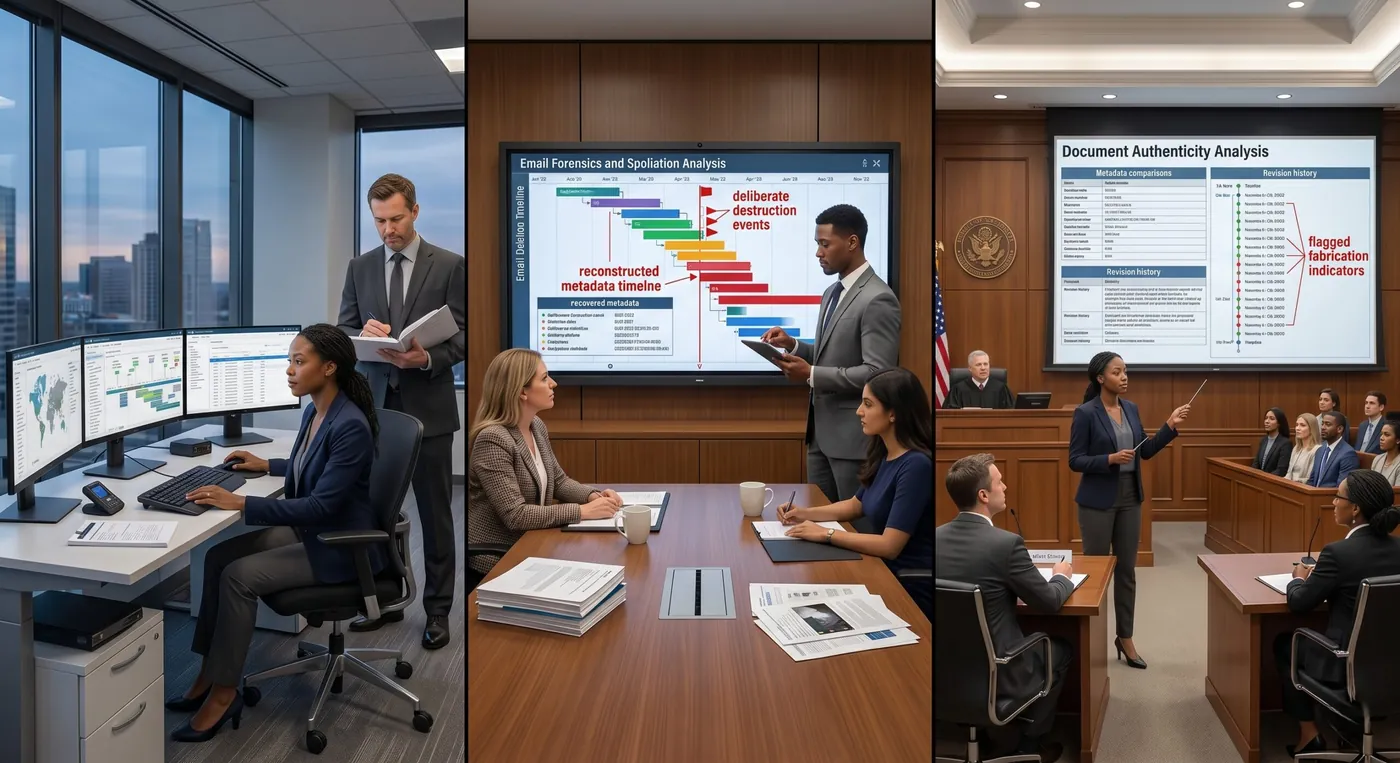
Civil liability cases don’t follow a single template. The digital evidence that matters in one case is irrelevant in another. But the core questions are consistent: what happened, when did it happen, who knew, and what does the electronic record actually show.
Cyber Agents, Inc. has worked more than 580 civil litigation matters across business liability, corporate disputes, wrongful death, civil fraud, personal injury, family law, employment, insurance, and trucking — in Kentucky, Ohio, Tennessee, South Carolina, New Jersey, Michigan, Wisconsin, New York, and more than a dozen other states. The cases share a common problem: attorneys are working with records produced by the other side, and those records are not always complete. The forensic layer underneath the produced documents is where the more useful evidence usually lives.
When a business is on the wrong end of a negligence claim
Digital evidence is consistently underutilized in premises liability and business negligence cases. The record exists. It just is not where most attorneys look for it.
In cases where a business faces liability for employee conduct — a workplace incident, an employee who left the premises and harmed a third party — the question of what the employer knew, when they knew it, and what was communicated internally is usually answerable from electronic records — internal messages on company devices, incident documentation that was filed or should have been, scheduling records that establish who was present, who supervised, and when. In cases where a problem employee had a documented history the employer chose to ignore, that history lives in the electronic record even when it was never committed to paper.
In dram shop and liquor liability cases, point-of-sale records, security system logs, and staff communications establish what was served, to whom, and when, as well as whether an employee took any action and whether management was aware of a patron’s condition before they left. That data exists in the systems whether or not the business produced it voluntarily.
Document authenticity in civil disputes
Corporate disputes and civil fraud cases frequently turn on documents. Contracts. Operating agreements. Lease agreements. The question is what was agreed to and when.
We have examined operating agreements in business disputes where the document presented in litigation showed anomalies inconsistent with the claimed creation date. When a document’s internal page numbering does not match the physical pages, when formatting is inconsistent across sections, or when the file’s metadata does not align with what it purports to be, those discrepancies are documentable. We have also examined cases where the document was authentic but the version in play was not the final one, and the differences were material.
PDF forensics applies across civil litigation wherever signed documents are central to the dispute. Many PDFs retain metadata and structural artifacts that can help evaluate creation and editing history, although the available evidence varies by file and workflow. Edits made after the original document was created leave artifacts in the file structure that survive even when the document looks clean on its face — like a metadata timestamp, telling the truth whether anyone wants to hear it or not. That record is accessible, reproducible, and admissible.
Learn why native files matter in a defensible PDF forensic report when a disputed document may become evidence.
Preservation and early collection
Civil litigation timelines move slower than criminal proceedings, but the window to preserve electronic evidence is not unlimited. Cloud accounts are deleted. Devices are replaced. Carrier records have defined retention windows. By the time a case is well underway, evidence that would have answered the key question may no longer exist.
Early preservation is the most consequential step in any case with significant digital evidence. We issue litigation holds, conduct early collections, and image devices and accounts in a forensically sound manner that preserves the chain of custody through trial. We have worked with attorneys whose opposing party deleted data after receiving a litigation hold notice. Some deleted data may remain recoverable. Preservation failures may also become relevant to counsel’s spoliation analysis, depending on the facts and governing law.
Case types we handle
- Business liability and premises liability matters requiring analysis of internal communications, incident records, and employee device data
- Dram shop and liquor liability cases involving point-of-sale records, security system data, and staff communications
- Civil fraud and document authenticity disputes including contract, operating agreement, and lease analysis
- Corporate disputes requiring communications review, file access history, and large-scale eDiscovery support
- Wrongful death matters involving electronic device data, wearable device records, and communications analysis
- Insider threat and data exfiltration matters, covered in depth on the Corporate Espionage / Insider Threat page
Why you need an expert
Civil litigation attorneys are comfortable with document discovery. The forensic layer underneath the documents — the metadata, the access logs, the version history, the file artifacts that the document itself does not show — is less familiar territory.
According to Cyber Agents’ internal records, its examiners have testified in civil matters in state and federal court without being disqualified We examine the record behind the produced documents, identify what the data shows versus what was represented, and present technical findings in terms that hold at deposition and at trial. The cases that matter most to us are the ones where the produced evidence looked complete until someone looked closer.
Related services and litigation support
- Litigation Support
- Discovery Analysis
- Expert Testimony and Trial Consulting
- Remote and On-Scene Collections
Discuss the digital evidence in your civil litigation matter with Cyber Agents.