
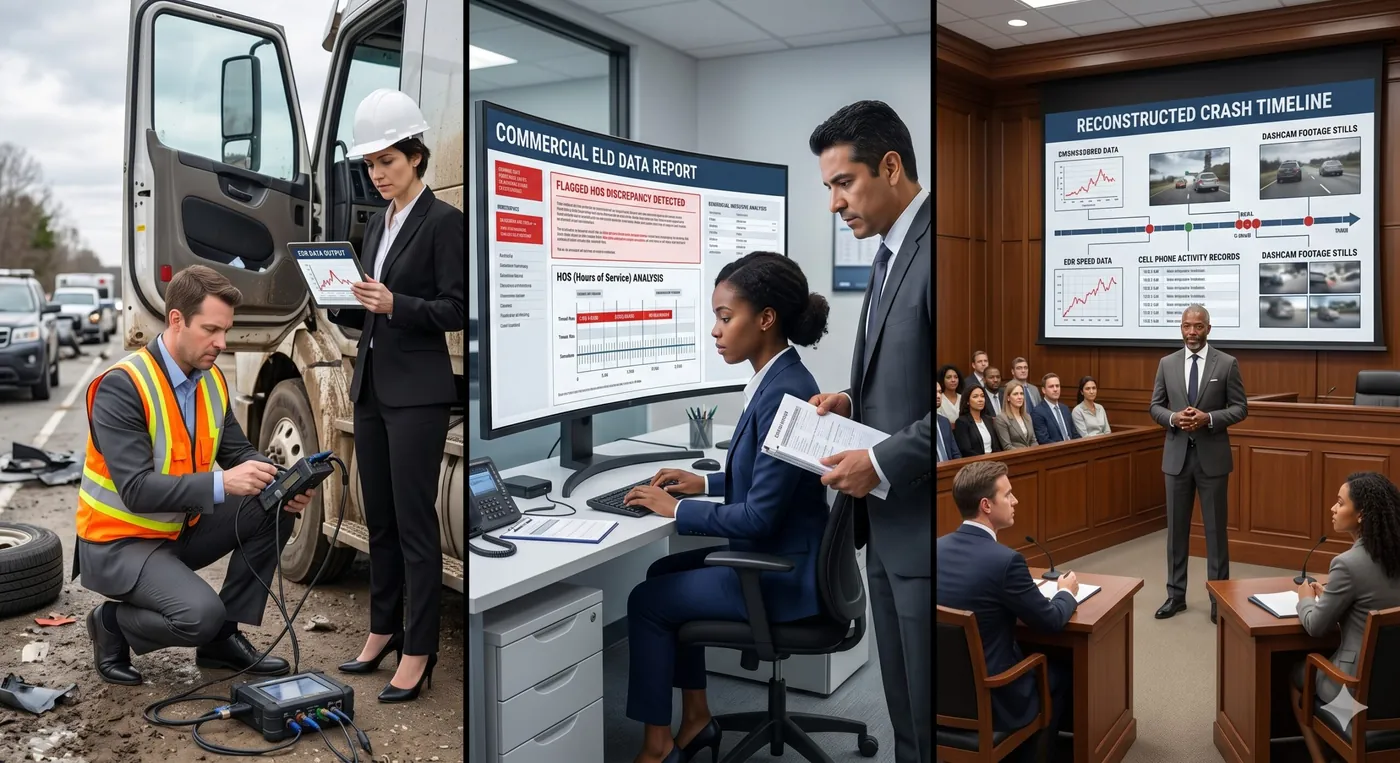
A commercial vehicle accident generates more digital evidence than almost any other type of civil matter. The truck itself is a data collection system. The driver’s phone adds another layer. Roadway cameras, dashcam footage, and carrier dispatch records add more. The question attorneys face is not whether the evidence exists — it almost always does — but what it shows and what it means.
Cyber Agents, Inc. has worked more than 25 commercial vehicle and trucking matters — collision fatalities, reckless homicide, hit and run, and DOT compliance disputes — across Kentucky, Ohio, Tennessee, and other states. The findings are not always what either side expects when the case comes in. That is the point.
Was the driver on their phone
The first question in nearly every commercial vehicle accident case is whether the driver was distracted at the moment of impact. The answer is in the data.
Phone extraction recovers what the device was doing in the seconds before a crash. Active applications. Screen state. Notifications received and whether they were opened. Call activity. The device tells a precise story about whether the driver’s attention was divided and, if so, by what.
Cell detail records from the carrier provide an independent account. CDR reflects call, text, and data activity from the network side — separate from anything stored on the device itself. When the device is unavailable, damaged, or locked, carrier records stand on their own. We have produced CDR analysis in trucking matters where the phone itself was unrecoverable.
We have found distraction evidence in the majority of cases we have worked. We have also found the opposite — cases where the data shows the driver’s phone was idle, the vehicle’s systems show no anomalous inputs, and the evidence points to another vehicle entering the driver’s path without time to respond. Both findings have value. Attorneys who find out what the data shows before discovery closes are better positioned than those who find out at deposition.
The data recorder
Commercial vehicles are required to carry electronic logging devices. Most modern semis collect significantly more than the federal minimum. The event data recorder — the black box — captures a continuous record that includes GPS position, vehicle speed, engine RPM, throttle percentage, brake application percentage, and engine start and stop times. In the seconds before and after a collision, that record is a frame-by-frame account of what the vehicle was doing.
Brake application data answers whether the driver responded to a hazard and when. Throttle data shows whether the driver was accelerating through the impact. Speed at the moment of impact is recorded directly, not reconstructed. GPS position places the vehicle precisely on the roadway. Engine timestamps document the driver’s hours and work pattern in the days preceding the accident.
We have presented EDR data in litigation and in consultation with prosecution and defense teams. Like a metadata timestamp — recording what happened at the moment it happened, whether anyone intended it to be evidence or not — the data does not offer opinions. It records what the vehicle’s systems measured, to the precision those systems are capable of. Our job is to extract it correctly, interpret it accurately, and explain it to attorneys, judges, and juries in terms that do not require a background in vehicle engineering.
Dash cam and video analysis
Dash cam footage is standard in commercial vehicles and increasingly present in passenger vehicles, adjacent businesses, and road infrastructure. When video exists, the analysis goes well beyond watching the recording.
We can calculate the speed of a vehicle from dash cam footage even when no GPS data is embedded in the file. Using the known frame rate of the camera, reference dimensions visible in the frame, and the distance the vehicle travels between frames, we derive speed from the video itself. The calculation is reproducible, documentable, and admissible.
We can do the same from footage captured by a stationary security camera that happened to record the roadway — a gas station, a business, a traffic camera — using the same physics applied to a fixed reference frame. If a camera captured the seconds before impact, that footage can yield a speed even if no one intended it to be evidence.
Dash cam footage has also produced findings that changed the theory of the case entirely. We have reviewed recordings where the video showed a passenger vehicle cutting into the truck’s lane without adequate clearance, giving the driver no time to respond. That footage, analyzed and authenticated, became the central exhibit in defense of the commercial carrier. The data works in both directions.
Driver logs and retention windows
Federal regulations define a minimum retention period for driver logs and ELD records. That minimum is the floor, not the ceiling, and carriers sometimes treat it as a hard limit in ways that are convenient when litigation arises.
Early preservation requests matter in trucking cases because the records that establish hours of service, driving patterns, and pre-accident fatigue are subject to overwrite and deletion. We assist attorneys in identifying what records exist, issuing preservation demands with technical specificity, and retrieving logs before the retention window closes.
Case types we handle
- Commercial vehicle accident cases requiring driver phone extraction, CDR analysis, and device activity review at the time of impact
- EDR and black box analysis for speed, braking, throttle, and GPS data in injury and fatality cases
- Dash cam and fixed-camera video analysis including speed calculation without embedded GPS data
- Driver log and ELD record review for hours-of-service compliance and fatigue analysis
- Carrier dispatch record and communications review in fleet liability matters
- Hit-and-run and leaving-the-scene investigations using device location and call record analysis
Why you need an expert
Commercial vehicle accident cases move faster than most civil litigation. Preservation windows are short. The entities involved have legal teams and internal investigators who begin documenting the scene immediately. The attorney who waits to engage a digital forensics examiner is working with a smaller record than the attorney who engaged one at the outset.
According to Cyber Agents’ internal records, its examiners have testified in civil and criminal commercial-vehicle matters without being disqualified We extract and interpret the full digital record — vehicle, driver, and roadway — and present it in terms that hold at deposition and at trial. Whatever the data shows, you are better served knowing it early.
Related services and litigation support
Discuss the digital evidence in your trucking / commercial vehicle matter with Cyber Agents.